
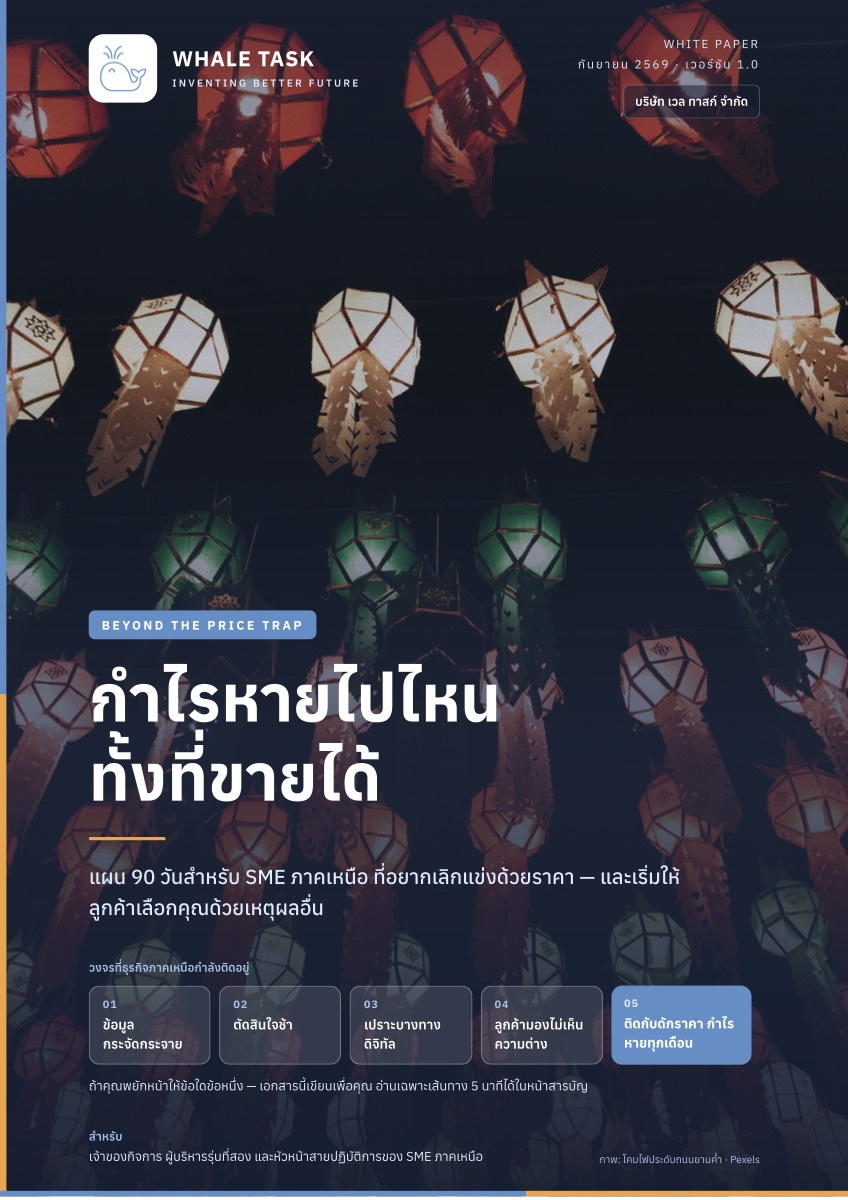
Where Does the Profit Go When Sales Are Fine?
A 90-day plan for northern-Thai SMEs that want to stop competing on price, and start being chosen for other reasons.
- 32 pages
- PDF · 5.5 MB
- Written in Thai
- Free
Who it is for
- Owners and second-generation leaders of SMEs in northern Thailand
- Operations heads dealing with rework, scattered data, and slow decisions
- Businesses that have not raised prices despite rising costs, and want a way out that is not a discount
Get the free white paper
Three fields. The download opens right away, and a copy goes to your email.
Research overview
The numbers the paper starts from
- 550,000
- SMEs in northern Thailand (approx.)
- 99.8% of all businesses in the region
- 2.28
- Digital maturity of northern SMEs
- Below the national average of 2.36
- 2.12
- Personnel and culture score
- The weakest dimension of digital maturity nationwide
- 42%
- Firms that have not raised prices
- Can absorb higher costs for only 3–6 more months
Sources: BOT Northern Office 2025 · ETDA Digital Maturity Index 2024 · BOT Business Voices, June 2026
Whale Task's core argument
The problem is not missing software. It is operating-system debt.
Scattered data, manual coordination, owner-bound decisions, and disconnected tools make a business slow to decide and fragile when a key person is away. Customers see less difference, and price becomes the default battleground. The answer is not "buy an ERP" or "use AI" but building business agility, and software earns its place only when it shortens those cycles.
The framework in the paper
The Price Trap Loop
Six self-reinforcing stages that many northern businesses are caught in without noticing.
- 1
Data lives everywhere
Stock, customers, costs, and orders exist in several versions and nobody knows which is right.
- 2
Decisions are slow
Teams wait to check numbers, wait for the owner's approval, or wait for the one person who knows.
- 3
Execution is inconsistent
Whether delivery is on time or service is good depends on who worked that day and who remembered.
- 4
Customers see no difference
When the service looks like the competitor's, customers compare the one thing they can see: price.
- 5
Margins thin out
More frequent discounts push investment in systems, people, and process further out.
- 6
Backlog accumulates
Manual work, Excel files, and workarounds pile up, and the next fix is harder than the last.
The loop feeds itself: thinner margins leave no money to fix the root cause, and it starts again at stage 1.
What is inside
32 pages: an hour cover to cover, or a five-minute reading path
Written for leaders who have to decide, not for the IT department. Every chapter cites public data and names its sources.
Five-minute path
Executive brief → 03 The Price Trap Loop → 05 The cost iceberg → 06B Readiness assessment → 06C Business case
- EBExecutive brief and executive answer
- 01Northern businesses have reached the point where the way of working must change
- 02The digital gap: having tools vs. using them
- 03The Price Trap Loop
- 04The real goal is business agility, not going digital
- 05Why the cheapest software usually becomes the most expensive
- 06Six signs a business is accumulating operating-system debt
- 06BReadiness assessment: is your business in the loop?
- 06CBusiness case: a Chiang Mai wholesale distributor, payback in 90 days
- 07From selling like everyone else to value customers will pay for
- 08Practical digital, by type of business
- 09The Whale Task Agility Stack
- 10A 90-day path to measurable value
- 11–16Measurement, procurement, strategic options, and implications for leaders
How you get it
Three steps, under a minute
- 01
Fill in three fields
Company, name, and email.
- 02
Download right away
The 32-page PDF opens as soon as you submit.
- 03
A copy by email
For reading on another device, or forwarding to your team.
FAQ
Before you download
Is it really free? Are there conditions?
Free, with no cost and no commitment. We ask only for company, name, and email so we can deliver the paper and follow up on whether it was useful.
What language is it in, and where does the data come from?
The paper is written entirely in Thai (32 pages). It draws on public data from the Bank of Thailand, ETDA, NESDC, the National Statistical Office, and the World Bank, with sources listed at the end of every chapter.
How are my details used?
Only to send the download link and to follow up on related topics. They are never passed to third parties, and you can opt out at any time by replying to the email.
I have read it and want to talk. What next?
Book a free initial business-system check-up. The team helps you see where your business sits in the loop and which fix to start with, without replacing everything.
Want to know where your business sits in the loop?
Whale Task offers a free initial system and process check-up, with priorities and a realistic budget range.